
Short answer first: if you stand or walk on hard floors for 8 to 12 hours, buy the PowerStep Pinnacle Work first. It has a real arch shell under the cushion, so it still supports you at hour ten instead of going flat at lunch. On a tight budget, the Dr. Scholl’s Work All-Day costs about $13 and is a fair test of whether an insole helps you at all. If you weigh over 220 lbs, skip both and go to the VALSOLE Heavy Duty further down.
One honest warning. An insole cannot fix a worn out shoe. What it can do is replace the thin liner your shoe came with, hold your arch up, and spread pressure across your heel. Prices checked November 2026, and prices move, so check the listing before you buy.
Quick picks
| Pick | Best for | Support style | Price guide |
| PowerStep Pinnacle Work | Most standing workers, plantar fasciitis | Semi rigid shell plus dual layer cushion | Around $46 |
| Superfeet All-Purpose Support High Arch (Green) | High arches, roomy work boots | Firm structure, deep heel cup | See price on Amazon |
| Dr. Scholl’s Work All-Day (Men’s) | First pair on a budget | Gel cushion, light arch | Around $13 |
| Timberland PRO Anti-Fatigue Technology | Boot wearers who want cushion first | Inverted cone foam | Around $25 |
| VALSOLE Heavy Duty Support | Workers over 220 lbs | Reinforced high arch, thick build | See price on Amazon |
| WalkHero Plantar Fasciitis Insoles | Budget arch support, wide shoes | Firm EVA arch, deep heel cup | Around $20 |
| KEEN Utility K-20 Cushion | Neutral arches who hate firm orthotics | Soft full length cushion | Around $25 |
1. PowerStep Pinnacle Work: best for most people who stand all day
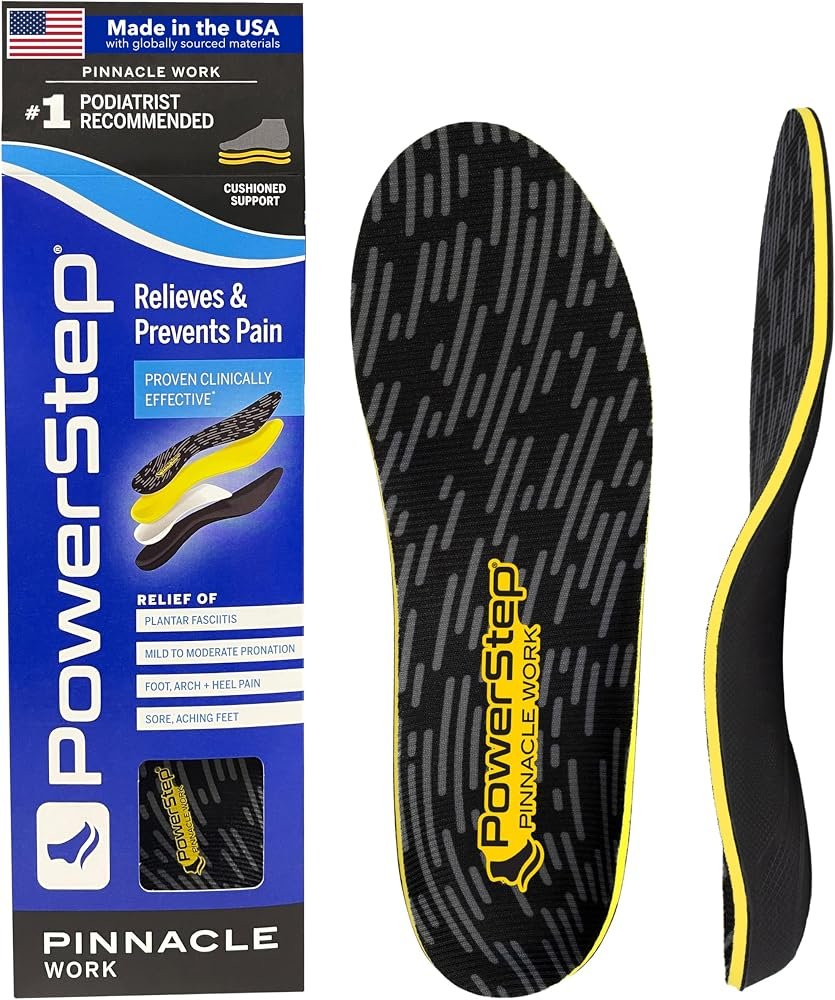
Who it suits: nurses, retail staff, warehouse workers with normal to slightly low arches, and anyone whose heel pain starts midway through a shift.
PowerStep is the brand podiatrists hand out most, and the Pinnacle Work is its version for hard floors and deeper footwear. A semi rigid arch shell does the supporting, with two layers of cushion on top. Soft insoles feel great in the shop and flat by week three. A shell does not compress, so day one support is close to what you get in month four. Owners praise the heel cradle, which stops the foot rolling inward.
Pros
- Real arch support that does not pack down mid shift
- Deep heel cradle helps plantar fasciitis and overpronation
- Thicker cushion than the regular Pinnacle, made for work shoes
- Properly sized, and made in the USA
Cons
- Thick. It crowds low volume shoes and needs a removable factory insole
- Some owners report squeaking against certain shoe linings
- The firm arch takes a week or two to get used to, and can feel too high on genuinely flat feet
Price: around $46.
2. Superfeet All-Purpose Support High Arch (Green): best for high arches
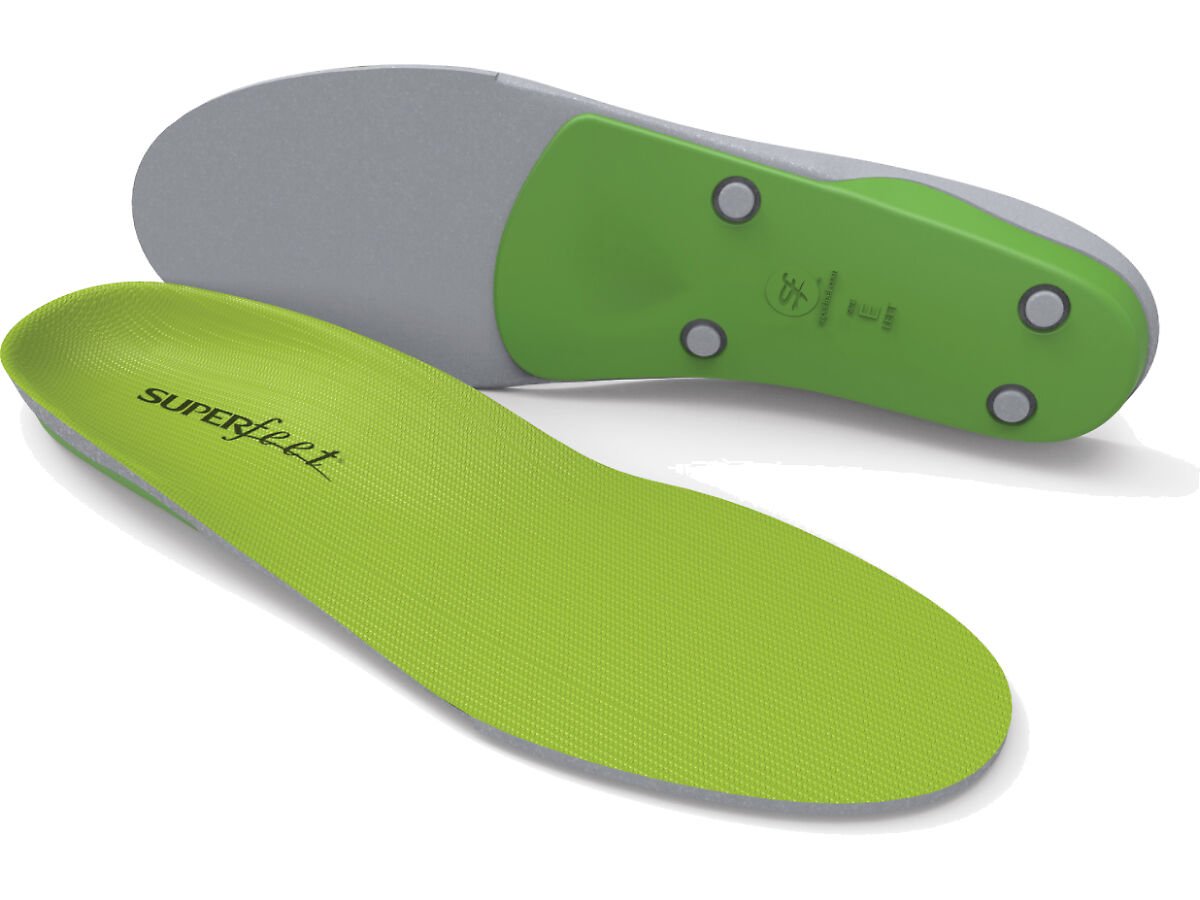
Who it suits: high arched workers in roomy work boots who want structure that lasts a year, not cushion that lasts a month.
This is the insole many people still call the Superfeet GREEN. It is a structure insole, not a comfort insole. A firm stabilizer cap runs under the heel and arch, the heel cup is deep, and the high density foam holds its shape long after gel inserts have gone flat. Work boot forums name it the default pick for high arches. The trade is softness: there is very little here, so it will not fix a sore ball of the foot. If your arch aches and your heel feels hammered by concrete, it probably will.
Pros
- Firm support that keeps its shape for 12 months or around 500 miles
- Deep heel cup spreads heel impact instead of landing it on one spot
- Trim to fit, works in boots, clogs and roomy trainers
Cons
- Too much arch for flat feet. Low arched owners often find it worse than the liner they removed
- Little cushioning, so it does little for forefoot soreness
- Can squeak in some shoes, and the break in period is real
Price: see price on Amazon.
3. Dr. Scholl’s Work All-Day (Men’s): the budget first test
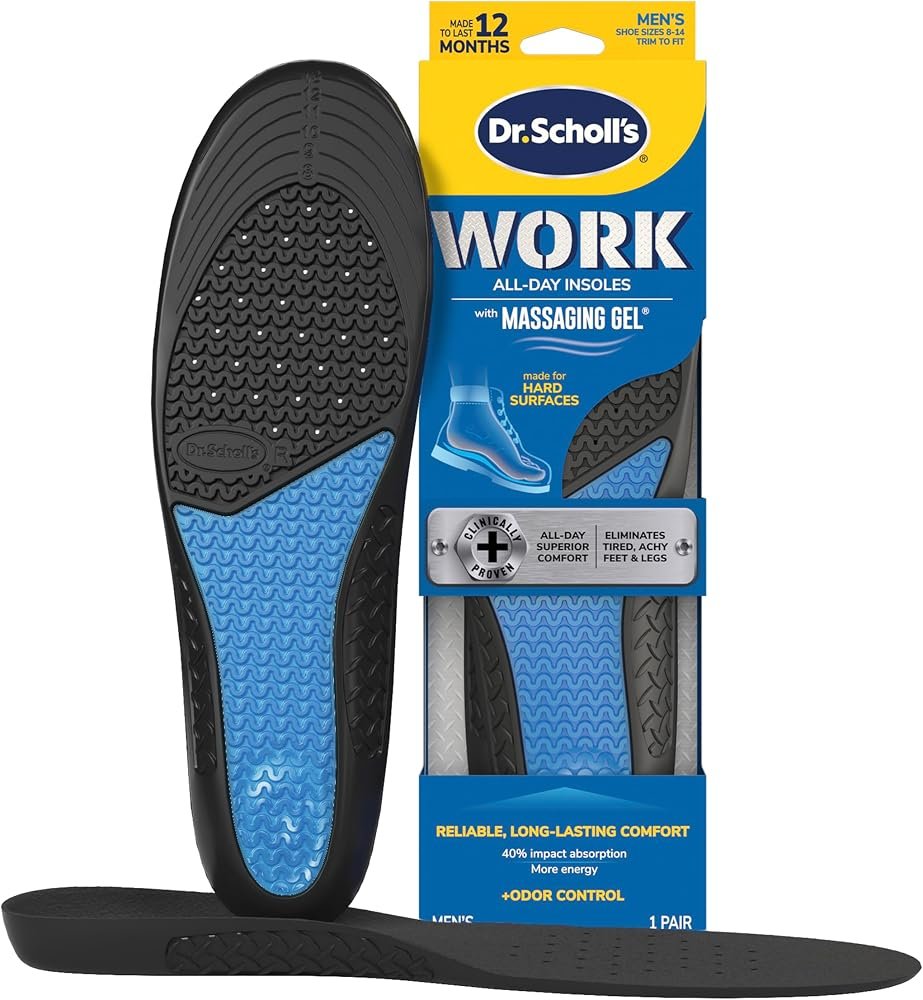
Who it suits: anyone unsure an insole will help, who wants to find out for the price of a lunch.
This is the best selling work insole in the country for a reason. It is built for standing, not adapted from a running insole, with massaging gel through the heel and forefoot, a reinforced arch and odor control. It is trim to fit, goes into almost any work shoe, and at about $13 it works as an experiment. Treat it as one, though. Gel and foam are exactly what flattens under a person standing still for ten hours, and many owners report the cushion bottoming out within a few months of daily use. If the experiment works, that is your sign to move up to the PowerStep or Superfeet.
Pros
- Around $13, the zero risk way to test whether insoles help you
- Gel heel and forefoot take the sting out of concrete and tile
- Trim to fit, fits most work boots and everyday shoes
Cons
- Cushion bottoms out fastest here under daily standing
- Arch support is light. It cushions more than it supports
- Some owners report squeaking and the top fabric wearing early
Price: around $13.
4. Timberland PRO Anti-Fatigue Technology: best cushion pick for work boots
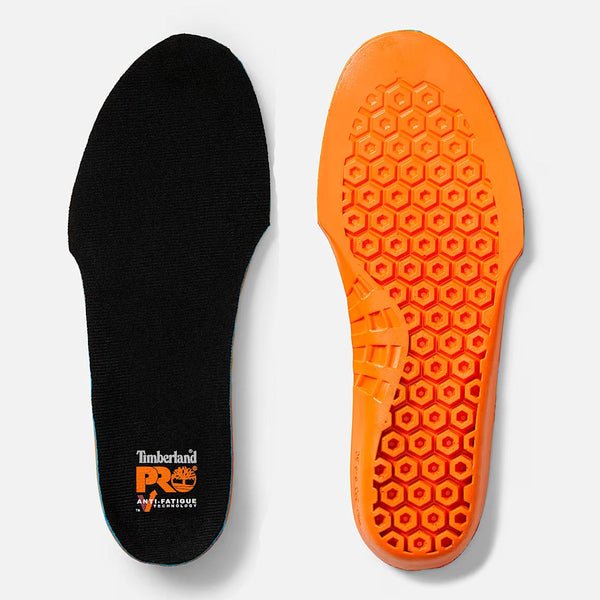
Who it suits: boot wearers on concrete who want shock absorption first and only mild arch help.
Timberland PRO built this insole around inverted cone foam. The cones compress under your foot and push back, which the brand sells as energy return. In plain terms it is a well made cushion insole shaped for work boots, with an OrthoLite footbed and a contoured arch that supports gently instead of correcting anything. Warehouse owners rate it a straight upgrade over the flat footbed most boots ship with. Know what you are not getting: there is no rigid shell, so if your arches collapse inward or you have plantar fasciitis, the PowerStep does more for you. The foam also packs down, so owners replace these around six months on daily wear.
Pros
- Strong shock absorption on concrete, made for work boots
- Sized S to 2XL, so most buyers skip trimming
- Around $25 and often discounted
Cons
- Cushion first design means limited real arch support
- Foam compresses and loses its bounce within months
- Wide size bands mean a less precise fit than sized orthotics
Price: around $25.
5. VALSOLE Heavy Duty Support: best for workers over 220 lbs
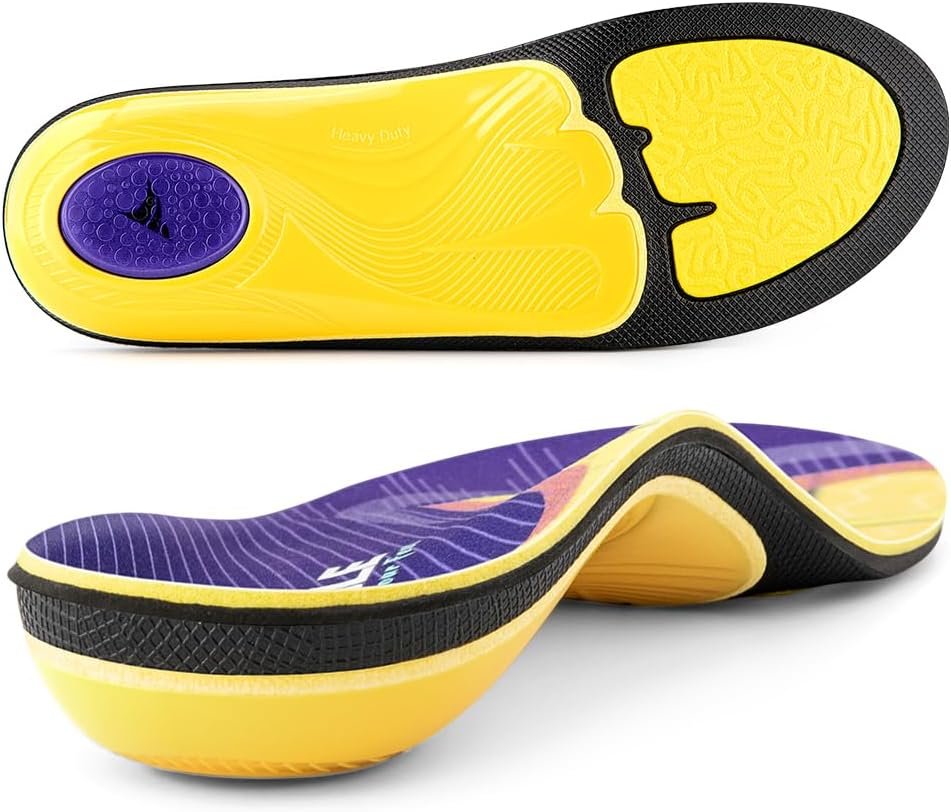
Who it suits: heavier workers and anyone who has crushed every soft insole they tried within a month.
Most insole lists pretend body weight does not matter. It does. Load is what flattens foam, and a 240 lb warehouse worker puts a different shift through an insole than a 140 lb retail worker. VALSOLE is an Amazon native brand built on this gap: a reinforced high arch insole rated by the brand for 220 lbs and up, with a firm support plate, a deep heel cup and shock absorbing padding on top. Big roundups skip it because it is not a household name. The trade is bulk. It is thick and stiff, needs a roomy boot, and can feel like too much arch for the first week. Some owners also mention squeaking until it settles in.
Pros
- Built and rated for 220 lbs plus, where most insoles quietly give up
- Firm high arch and heel cup control pronation under heavy load
- Costs far less than premium orthotic brands
Cons
- Thick and stiff. It will not fit slim shoes, and low arches may hate it
- Sizing runs large for some owners, so check the chart in millimeters
- Break in is not optional. Start with a few hours a day
Price: see price on Amazon.
6. WalkHero Plantar Fasciitis Insoles: budget arch support that actually has an arch
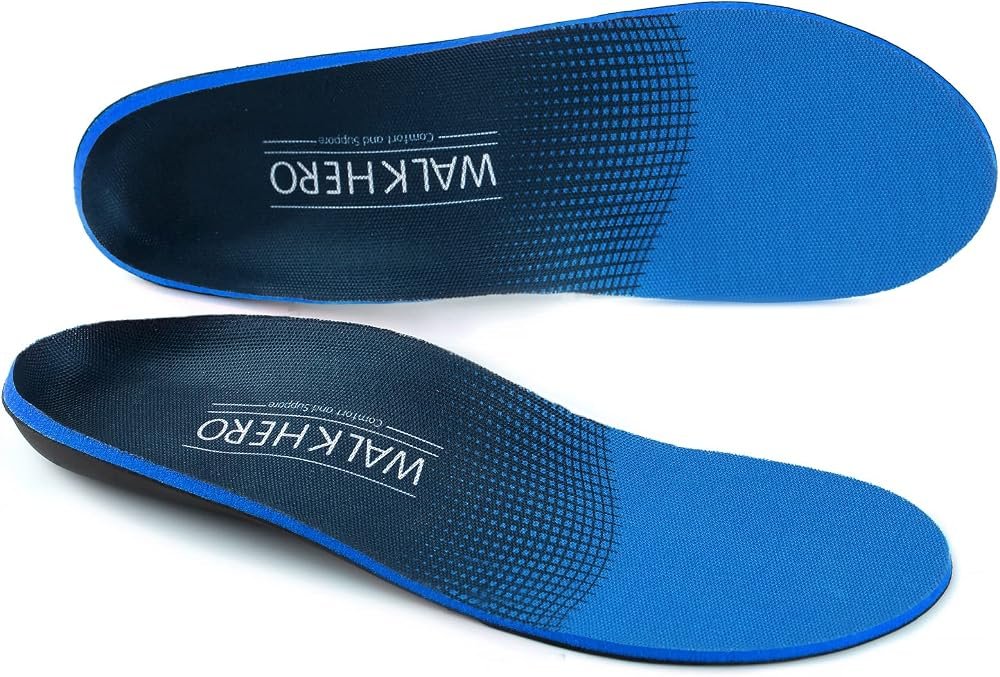
Who it suits: flat to normal arches in wide, high volume shoes, and buyers who want real arch shape for about $20.
WalkHero is another Amazon first brand, and its insole has sold steadily since 2017 because it does the one thing cheap insoles usually skip: it has a firm, high arch and a deep heel cup instead of a flat pad with a bump printed on it. The EVA build suits wide, roomy footwear such as work boots, and owners with plantar fasciitis and flat feet are its core audience. Set expectations at the price. The foam is not in the Superfeet league for lifespan, and owners report the support softening with heavy daily use, plus top fabric wear and the occasional squeak. At about $20, most buyers treat it as a six month insole and are fine with that.
Pros
- Firm arch and deep heel cup at a budget price
- Made for wide, high volume shoes and work boots
- Long track record and a large owner base for an Amazon brand
Cons
- Foam bottoms out sooner than rigid shell insoles under daily standing
- High arch is wrong for some feet and most low volume shoes
- Squeaking and top fabric wear show up in owner reviews
Price: around $20.
7. KEEN Utility K-20 Cushion: best soft option for neutral arches
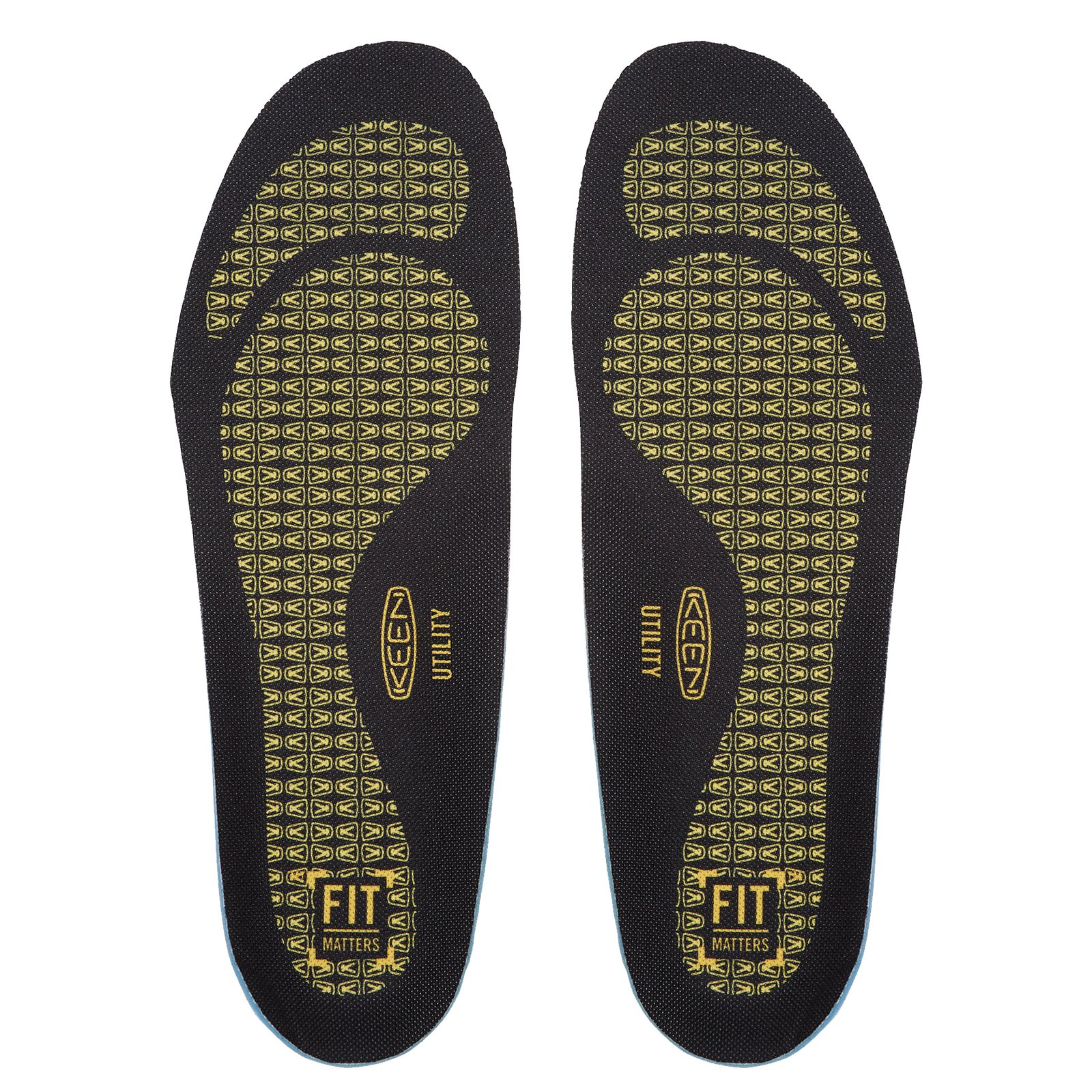
Who it suits: neutral arched workers who tried a firm orthotic, hated it, and just want their boots to feel less harsh.
The K-20 is the cushion footbed from KEEN’s work boot line: full length high rebound foam, medium arch support, a stabilizing heel cup and probiotic based odor control. There is no hard shell and no correction going on. It simply replaces a worn boot footbed with a fresh, springy one designed for work footwear, which is why KEEN boot owners buy it as a like for like refresh. Its limits are the flip side of its comfort. Foam flattens, medium support will not hold up a collapsing arch, and sizing is aimed at men’s work boots. If your feet ache from impact, this is the comfortable answer. If they ache from alignment, go back to pick one.
Pros
- Soft, springy cushion with no painful break in period
- Designed for work boots, with a proper heel cup and odor control
- Around $25, and an easy refresh for worn boot footbeds
Cons
- Cushion only. Not enough support for flat feet or plantar fasciitis
- Foam packs down over a season of daily wear
- Mostly men’s sizing, limited options for women
Price: around $25.
Insole or new shoes: which do you actually need?
The two purchases fix different problems, so answer this before spending anything.
Buy the insole first if your shoes are under a year old, the tread is still good, and your pain sits in the arch or heel. A $13 to $46 insole is a cheap test, and if it works you have saved the price of new shoes.
Buy new shoes if the midsole is dead. Press your thumb into the heel of the sole. If it feels hard and packed instead of springy, or the shoe leans inward when you stand it on a table and look from behind, no insole rescues it. The insole sits on top of that dead midsole and inherits the problem. The same goes for shoes that are too narrow or a half size small, because insoles take up room.
Buy both, in this order, if you are starting a job on your feet: shoes first, fitted at the end of a shift when your feet are swollen, then an insole two weeks later if your arches still ache. Our nurses shoes guide and flat feet guide on this site cover the shoe side. And pain that is sharp, one sided, numb, or still there after three weeks in decent shoes and insoles is a podiatrist visit, not a bigger shopping list.
Sizing and trimming guide
- Start from the removable liner. Pull it out. If your shoe has no removable liner, only thin insoles like the Dr. Scholl’s fit without crowding your toes.
- Buy your shoe size. Insoles are sold in shoe size ranges. Between sizes, buy the larger one and trim.
- Trim with the old liner as the template. Lay it on the new insole, toes aligned, trace, and cut a little large. Cut only the toe end, never the heel or arch.
- Check the fit standing up. Toes should not touch the end, and the insole’s arch should sit under your arch, not your heel.
- Break in firm insoles. With PowerStep, Superfeet and VALSOLE, wear them 2 to 3 hours on day one and add time across a week.
- Replace on a schedule. Foam and gel last about 6 months on daily shifts, shell insoles 9 to 12 months. When the heel cushion feels dead, it is dead.
Mistakes people make with work insoles
- Buying the softest insole in the shop. Soft feels best for one hour and worst at hour nine. Standing still compresses foam far faster than walking does, so structure beats squish for standing jobs.
- Guessing their arch type. A high arch insole under a flat foot is the most common reason people decide insoles do not work. Wet your foot, step on cardboard, and read the print. Full print means low arch. A thin connecting strip means high arch.
- Stacking an insole over the factory liner. Two insoles crowd the shoe, lift your heel out of the heel counter and cause blisters. One comes out before the other goes in.
- Putting a thick orthotic in a slim shoe. If your toes feel jammed, move it to your boots and use a thinner pick in the shoe.
- Expecting an insole to fix a dead shoe. The most expensive mistake here. People buy three insoles before buying the shoes they needed.
- Wearing one pair seven days a week. Foam recovers between shifts. Two cheaper pairs rotated daily outlast one premium pair worn every day.
Frequently Asked Questions
What is the best insole for standing on concrete for 12 hours?
A structured insole with a shell, like the PowerStep Pinnacle Work. Concrete gives nothing back, so the insole has to supply both support and shock absorption, and pure gel or foam compresses flat under a full shift of standing. Heavier workers should look at the VALSOLE Heavy Duty for the same reason.
Are gel insoles good for standing all day?
They are fine as a cheap first test and for lighter use, but gel is the first thing to bottom out under long static standing. If a $13 gel insole helps for a few weeks and then fades, that is useful information. An insole helps you, and a structured one will help for longer.
How long do work insoles last?
On daily 8 to 12 hour shifts, expect about 6 months from foam and gel insoles and 9 to 12 months from shell insoles like PowerStep and Superfeet. Body weight, concrete floors and never rotating pairs all shorten that.
Can I put insoles in nursing clogs?
Only if the clog has a removable footbed. Many professional clogs, including most Dansko models, have a fixed contoured footbed that takes no aftermarket insole. Forcing a thick insole into a clog raises your foot and makes the clog unstable, which is a safety problem on hospital floors.
Do insoles help knee and back pain from standing?
They can, when the pain starts with your feet rolling inward, because a supported arch changes how force travels up the leg. They are not a treatment for knee or back problems on their own. Persistent joint pain deserves a clinician, not a product page.
Verdict
Most standing workers should buy the PowerStep Pinnacle Work and stop reading insole reviews: real support, enough cushion, proper sizing, built for the boots and clogs people actually stand in. High arches belong with the Superfeet Green. Tight budgets start with the Dr. Scholl’s Work All-Day as a $13 test. Workers over 220 lbs go straight to the VALSOLE Heavy Duty, the only pick here built for their load. Whichever you choose, replace the factory liner, break it in slowly, and judge it at the end of a full shift, not in the first five minutes.